Showing posts with label World War I. Show all posts

Sunday, 3 May 2015

We Will Remember Them: Thomas Alexander Mills d. 3 May 1915

The first person that this series will be remembering is the second cousin of my step-great grandmother, the attached chart shows how we are related. Although at the time of Private T.A. Mills death she was a widow who was yet to marry my recently widowed great grandfather.

Thomas Mills was the son of a military man, his father Alexander had fought during the Boer War with the 1st Inniskillings being awarded the King's Medal with two clasp, Queen's Medal with five clasps and Distinguished Service Medal. Unlike many of the young men who will be featured in this series he was a member of His Majesty's Forces before the declaration of war having signed up two weeks earlier.
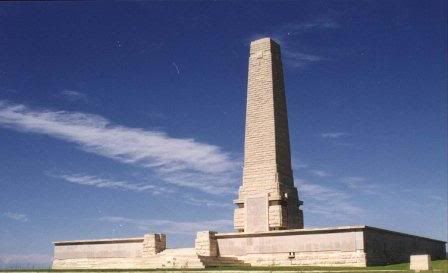
The Helles Memorial, Turkey where he is remembered
He joined the Royal Marine Light Infantry (Plymouth Division) and it was with them that he formed part of the 29th Division that engaged in the initial landings in the Dardanelles on 25th April 1915. The campaign is better known today by the name of the peninsula where the Allied Forces got pinned down for months without advancing; Gallipoli.

Just over a week after the initial landings he was declared missing, his father sought further information, but as too many soldiers from the naval division of the army were listed as missing at the time there was a just a standard response.

On Friday 4th August 1916 in First Derry Presbyterian Church his name was among those read out in an act of remembrance for the young men of the City who had already given their lives during the first 2 years of this War. The location of this service means that it was very possible that many of my family on both my father's and mother's sides could have been present as both their father's families worshiped in that church around this time.

The tragedy for the family didn't end with the end of the war abroad. On 23 June 1920 while walking through the streets on the city side of Londonderry his mother Margaret Mills (née Mowbray) was shot in the chest and died as a result of the wounds there had been gunfire in the area around Bishop Street all day and the inquest had asked if the bullet could have come from the predominantly unionist Waterside area across the River Foyle, but found that it probably had come from the republicans on the Cityside. She was an unfortunate victim of the civil war that still saw many members of my family living surrounded by the republicans on the west bank around the Fountain and Abercorn Road. The Mills at this time were living on Orchard Row just off Foyle Road.

Pvt. Thomas Alexander Mills, Royal Marine Light Infantry, Plymouth Bttn. Royal Naval Division
Born Londonderry City, Ireland 1 Mar 1897
Died Gallipoli, Ottoman Empire (Turkey) 3 May 1915

We will remember him


The Royal Marine Light Infantry during the War

The Royal Marines had been founded in 1664 and men had been billeted in Plymouth, the Division in which Thomas was attached, since the formation. In 1855 the marine infantry forces had been renamed the Royal Marine Light Infantry (RMLI) and from that time they were set up to lead on landings on foreign and hostile shores to act as the initial wave as skirmishers.


Thursday, 26 March 2015

Death of a Poet: We Will Remember Them Julian Grenfell

Many of the young men who went into battle in World War I were poets, either established or as a way to express themselves and fill the hours of waiting to go over the top. As an act of remembrance to those that never returned to their civilian existence on centenary of the day that they fell I will publish one of their poems.

Today marks 100 years from the passing of Julian Grenfell who as a Captain in the Royal Dragoons on the 13th May had been standing talking to fellow officers near Ypres when a shell landed near them. A splinter hit him in the head and he was transferred to hospital in Boulogne where his mother, father and sister were at his bedside when he died of his wounds. The day after his death alongside news of his death his most famous was published in The Times. 

Into Battle

The naked earth is warm with Spring,
And with green grass and bursting trees
Leans to the sun's gaze glorying,
And quivers in the sunny breeze;
And life is Colour and Warmth and Light,
And a striving evermore for these;
And he is dead who will not fight,
And who dies fighting has increase.
The fighting man shall from the sun
Take warmth, and life from glowing earth;
Speed with the light-foot winds to run
And with the trees to newer birth;
And find, when fighting shall be done,
Great rest, and fullness after dearth.
All the bright company of Heaven
Hold him in their bright comradeship,
The Dog star, and the Sisters Seven,
Orion's belt and sworded hip:
The woodland trees that stand together,
They stand to him each one a friend;
They gently speak in the windy weather;
They guide to valley and ridges end.
The kestrel hovering by day,
And the little owls that call by night,
Bid him be swift and keen as they,
As keen of ear, as swift of sight.
The blackbird sings to him: 'Brother, brother,
If this be the last song you shall sing,
Sing well, for you may not sing another;
Brother, sing.'
In dreary doubtful waiting hours,
Before the brazen frenzy starts,
The horses show him nobler powers; -
O patient eyes, courageous hearts!
And when the burning moment breaks,
And all things else are out of mind,
And only joy of battle takes
Him by the throat and makes him blind,
Through joy and blindness he shall know,
Not caring much to know, that still
Nor lead nor steel shall reach him, so
That it be not the Destined Will.
The thundering line of battle stands,
And in the air Death moans and sings;
But Day shall clasp him with strong hands,
And Night shall fold him in soft wings.


Grenfell attended Eton along with fellow war poet Patrick Shaw-Stewart, before going up to Balliol College Oxford, where he is known to have bullied Philip Sassoon who was later an MP and a cousin of Siegfried. He joined the army in 1910 and , he was the son of William Grenfell who had been Liberal MP for Salisbury (1880-86) and Hereford (1892-3) resigning after falling out with Gladstone over Home Rule, he returned to the commons as Conservative MP for Wycombe (1900-1905) before becoming Baron Desborough. His next oldest brother Gerald William died about 2 months after his elder brother about a mile away from where the shell struck and the youngest brother Ivo George as to perish in a car crash in 1926.

On 1 January 1915 Julian Grenfell was awarded the Distinguished Service Order:
On 17 November he succeeded in reaching a point behind the enemy's trenches and making an excellent reconnaissance, furnishing early information of a pending attack by the enemy.

There are very few poems by Grenfell that exist. But some had been published in the Eton College Chronicle and while studying there also in London World and Vanity Fair.

Julian Henry Francis Grenfell DSO 30 March 1888 London, England - 26 May 1915 Boulogne-sur-Mer, France

See also: The other poets who died in the war.

Monday, 28 July 2014

We will remember them: Introduction to an occasional series


At the going down of the sun and in the morning, We will remember them
At eleven am on this day 100 years ago Austria declared war on Serbia. Due to the interconnectiveness of treaties across Europe within a week we had most of the major powers declaring they would be taking part in the Great War, the First World War.

I knew that a number of my great uncles had served in the Second World War, but all of them had survived to tell the tale. Though very few of them talked about it much. But with an interest in the family genealogy I was always wondering if any of the family had fought and died in that first world war. The earliest bits of the family tree seemed to indicate that due to a quirk of ages that none of the close to blood line relatives were involved.

But then I started to look a little further afield, up the tree for people who had married in the the family and sideways from the generations who were around at the time, looking for cousins or people from within that the family would have known I found there are names of distant relatives whose names are written upon those monuments that were erected following that conflict to mark the five and half million who had died on the Allies side. Many within my family's history had gone to serve, some had even returned from overseas as the family had emigrated to the USA or Canada and came to serve.

This series will act as a act of remembrance to those close to my family at the time who died in the service of their nation. Little did Laurence Binyon know when he wrote the words that follow (the full version) in the early months of the conflict that the way that we will remember them 100 years on in not necessarily by leafing through old, dusty, newspaper archives but through a medium that they wouldn't even have dreamed off. Radio wasn't even a mass media until after the War. Television some further years off and as for using a screen to access information from around the world in a matter of seconds, well that would have been unthinkable.

On the days that those I have discovered fell I shall writing a little bit about them and the battle in which they gave the ultimate sacrifice and the regiment or service they fought with. I shall remember them.

Ode to Remembrance

With proud thanksgiving, a mother for her children,
England mourns for her dead across the sea.
Flesh of her flesh they were, spirit of her spirit,
Fallen in the cause of the free.
Solemn the drums thrill; Death august and royal
Sings sorrow up into immortal spheres,
There is music in the midst of desolation
And a glory that shines upon our tears.
They went with songs to the battle, they were young,
Straight of limb, true of eye, steady and aglow.
They were staunch to the end against odds uncounted;
They fell with their faces to the foe.
They shall grow not old, as we that are left grow old:
Age shall not weary them, nor the years condemn.
At the going down of the sun and in the morning
We will remember them.
They mingle not with their laughing comrades again;
They sit no more at familiar tables of home;
They have no lot in our labour of the day-time;
They sleep beyond England’s foam.
But where our desires are and our hopes profound,
Felt as a well-spring that is hidden from sight,
To the innermost heart of their own land they are known
As the stars are known to the Night;
As the stars that shall be bright when we are dust,
Moving in marches upon the heavenly plain;
As the stars that are starry in the time of our darkness,
To the end, to the end, they remain.
Laurence Binyon September 1914