Apparently Peter Robinson's moves to attend GAA games are to woo liberal unionists according to today's Belfast Telegraph.
If the DUP really want to woo liberals, why don't they start to send a representative to the discussion panels that form part of the Pride weeks around Northern Ireland. Until they are seen to be listening to everyone they cannot be seen as 'liberal'.
Thursday, 9 February 2012

Wednesday, 8 February 2012
Neither a Left Liberal nor a Right Liberal, Just Liberal

I see that Liberal Left have launched their website today, which includes a look at their values. To be fair after my tirade at Charlotte Henry last night I'm going to look at those values against the party's constitution and other sources.
Bearing in mind that my membership of the Social Liberal Forum already in the eyes of some places me to the left of the party. If I really wanted to work closely with Labour I would already have taken up one of their many invitations to work for them. Therefore I've taken a look at the entire values of Liberal Left and at times (in red and italics) compared them directly to the preamble of the constitution.
Liberal Left is initiated by Liberal Democrats who oppose the party’s membership of the Coalition. It is open to all who seek co-operation across the liberal left in order to provide an alternative to the current government. The point has been made numerous times before that the maths of such a progressive left was not there in 2010. In all possibility a minority government would have led to fear in the markets and possibly a failure of the UK economy, leading to another election which the Conservatives would have won by now. So the alternative such an alignment would have resulted in would have been a Conservative majority Government by the end of 2011.
From the party constitution the party "seeks to promote a sustainable economy" and also "ensure that there is a just and representative system of government with effective Parliamentary institutions." While the election of May 2010 didn't issue a clear result, one thing it did indicate was that the Conservatives had more support for how to deal with issues than Labour. Not a majority opinion, but a stronger votes supporting that opinion. To then keep a party in power that had failed to retain the support of the people how is that "just". I know the phrase relates to voting system change, but under the current system how would that appear to be just or representative?
Liberal Left articulates policy positions within the Liberal Democrats which should be central to a radical party. Such views have informed recent general election manifestos on which our candidates have stood, and on which our MPs have been elected. These views are not currently being voiced effectively in a party whose radical traditions have become muted in government, and whose leaders have taken the party’s policy position to the right. We are now part of a Government which is Eurosceptic to be fair here Nick did break his silence regarding Cameron's veto, neo-liberal and socially conservative.
The Economy and Public Policy
The Liberal Democrat leadership has argued that Coalition was necessary to eliminate the structural deficit in a single parliament. It is now clear that this objective will not be achieved. Whilst the right of the party will use this failure to argue for a continuation of Coalition policy into the next parliament, Liberal Left believes there are different lessons to be learned.
The Liberal Democrats argued during the 2010 General Election that Conservative plans to eliminate the structural deficit in a single parliament would remove growth from the economy and that their impact would fall disproportionately on those least able to afford them, increasing the gap between the rich and poor and further dividing the country. This is exactly what has happened
We support a different economic strategy – one that does not involve blaming the country’s problems on the demonised poor, nor on apparent ‘overspending’ by the previous government (spending which Liberal Democrats did not say should be reduced). Such a strategy should involve the budget deficit being reduced more slowly, with hardships falling squarely on the shoulders of those who benefited from government bail-outs. That would be in line with the scope and timing proposed by the 2010 Liberal Democrat manifesto. It should also involve prioritising investment in public works, especially green jobs, to boost employment.
This sentiment comes straight out of the preamble:
"We will work for a sense of partnership and community in all areas of life. We recognise that the independence of individuals is safeguarded by their personal ownership of property, but that the market alone does not distribute wealth or income fairly. We support the widest possible distribution of wealth and promote the rights of all citizens to social provision and cultural activity. We seek to make public services responsive to the people they serve, to encourage variety and innovation within them and to make them available on equal terms to all."
However Liberal Left have failed to look at the erosion of some of those means by the previous Labour government. Taxing of the minimum wage, increasing employee National Insurance contributions, failure to link pensions to the rate of inflation. The fact that in the current coalition we have pushed to lift the threshold for personal taxation toward the NMW, restored the link between state pensions and RPI are steps to lifting some of that those hardest hit out of poverty. I admit there were failing in the Welfare Reform Bill in recent days.
But there are wider issues at stake than public policy responses to the economic crisis. Liberals have long argued against concentrations of power and resources, whether in the hands of the state or of private institutions. Social Democrats have long argued that inequality in wealth, income and esteem undermine social cohesion. The financial crisis is the result of decades of neo-liberal ideology and politics which has ignored these lessons. Instead public policy has allowed financial markets to consolidate power in the hands of unaccountable institutions, has disempowered communities, undermined local economies and has redistributed income and wealth from the bottom to the top. The crisis has also allowed a rebirth of social conservatism as those on the right try to blame the nation’s ills on the poor, the public sector, and a decline of family values.
I agree with the final line of the above. The fact that Cameron and Osborne are also failing to lay any of the blame on the private sector, especially the banks is a farce. Although there is the permanent levy on banks, something which Ed Miliband and Labour seem to constantly ignore.
Although the language above does tend to go a little too far in the other direction. Bear in mind the the constitution of the party also says:
"We want to see democracy, participation and the co-operative principle in industry and commerce within a competitive environment in which the state allows the market to operate freely where possible but intervenes where necessary."
People understand this. The popularity of progressive single issue campaigns shows a genuine appetite for progressive politics. We believe that Liberal Democrats should be part of this politics, not its target. This is a time for Liberals and Social Democrats to work together for a fairer and more democratic Britain in which people and communities are empowered to build a sustainable future and in which disparities of income, wealth and power are reduced. We must also work together to promote our shared approach to public services and attitudes towards social justice. We believe the state has a clear responsibility to enable people to make the most of their own lives, in contrast to the coalition’s mission to slash the role of the both local and national government dramatically.
Again from the constitution:
"We believe that people should be involved in running their communities."
and
"We believe that sovereignty rests with the people and that authority in a democracy derives from the people. We therefore acknowledge their right to determine the form of government best suited to their needs... We similarly commit ourselves to the promotion of a flourishing system of democratic local government in which decisions are taken and services delivered at the most local level which is viable."
While this does back up some of the above it also runs contrary to the stated claim to be an opposition to the current government, which when you look at it was determined by the will of the people, whose self determination and votes went towards it.
Some of the arguments that are made seem valid, but most of the conclusions are in my opinion flawed. Yes in the past I have been more than willing to work with Labour, Greens where our policies match up. But the same is also true with parties to the right Unionist Parties in Northern Ireland or the Conservatives. It was Paddy Ashdown who as leader in 1995 led the party to end its policy of "equidistance". This closer association with one party over the other only led to an increase of 8 seats from the 20 held previously. Most of our gains since then have come when not associated with one party or the other but opposing both when we have to and agreeing with one over the other when we can.Political Strategy and Public Trust
The political result of the coalition has been disastrous for the Liberal Democrats. The party has haemorrhaged support, activists, members and councillors. The effectiveness of our policy gains such as increasing tax allowances at the bottom of the income scale and the partial implementation of the pupil premium, have been dwarfed by the impact of others, including the rise in VAT and loss of standards funds in education. The party’s volte-face on tuition fees has fundamentally undermined our trustworthiness.
Not one of these comments I disagree with. However, having worked and campaigned in Labour heartlands people were prepared to vote for me because I was neither Labour nor Conservative, but different. Not at the behest of unions nor business but there for the people, all people not just those who were unionised.
If there is to be any future for the liberal left in British politics, we believe that there must be overt and public dialogue between Liberal Democrats, Labour, Greens and others on the democratic left. There is a centre-left majority in the UK but it all too often fails to be expressed because of parties not being clear in advance of an election about who their preferred coalition partners would be. Many of the political problems faced by the current coalition flow from it being a government which most Liberal Democrat voters did not want. It is ideologically unsustainable and without a mandate.
A future coalition with Labour and others on the liberal left is more likely to secure Liberal Democrat goals than a further coalition with the Conservatives I thought a Government where Liberal Democrats were the majority was the most likely way to secure those goals and we should actively work to make that possible. If that is ever to happen, future centre-left co-operation must not founder on personal hostilities, and policy differences/similarities must be fully understood having worked in Scotland and Northern Ireland I know that policy similarities do come from all points of the political spectrum. If coalitions are to become more common, then voters cannot be left in the dark over what parties are likely to do (or not do) from their manifestos if they co-operate They weren't left in the dark this time, Nick said he would start talking to the party with the greatest mandate that is what was done. However, in coalition the manifesto is a thrust of what the party is expecting to do, the Lib Dems have gone some considerable way to implementing a lot of their's. The public deserves to be given a clear idea of what co-operation between Liberal Democrats, Labour the Greens and others would mean in terms of public policy if they are to be expected to trust such a government.
Just as I don't want to see the party consumed into a permanent coalition with the Conservatives, nor do I want to see us as continually only able to operate with the broader left. Both scenarios limit our ability to be radical, both scenarios bind our hands in different ways and fail to allow us to find the best solution for any given. If bound to the Conservatives we would be looking out for business all the time to the neglect of the workers, if the other way we'd be at the beck and call of the unions and not the employers.
I leave the final argument to the preamble of the constitution:
"We will foster a strong and sustainable economy which encourages the necessary wealth creating processes, develops and uses the skills of the people and works to the benefit of all, with a just distribution of the rewards of success. We want to see democracy, participation and the co-operative principle in industry and commerce within a competitive environment in which the state allows the market to operate freely where possible but intervenes where necessary. We will promote scientific research and innovation and will harness technological change to human advantage.
"We will work for a sense of partnership and community in all areas of life. We recognise that the independence of individuals is safeguarded by their personal ownership of property, but that the market alone does not distribute wealth or income fairly. We support the widest possible distribution of wealth and promote the rights of all citizens to social provision and cultural activity. We seek to make public services responsive to the people they serve, to encourage variety and innovation within them and to make them available on equal terms to all."
That is neither the perogative of Liberal Left, nor Liberal Right! That is what it means to be Liberal.
Tuesday, 7 February 2012
Dear Charlotte, it's social not socialist and is constitutional
Charlotte Henry seems to have an axe to grind with every Liberal Democrat who doesn't agree with her. That doesn't seem to be very liberal nor democratic.
Now I don't mind discourse within our party, in fact that is what is so great about our party, we do have discourse and we come to a democratic consensus that we then rally behind. The one constant is all the 23 years I have been around this party has been fairness. Look at the preamble of our party's constitution, that is the yardstick against which I measure every policy that is brought before conference for my consideration and vote. I have actually voted against some amendments or policies laid before conference because although I agree with the general thrust parts of the methods that they aim to achieve them do not meet these criteria.
Whilst I somewhat agree with Charlotte that we are not a party that can be defines as left or right, and therefore do not see the need for a Liberal Left movement, I do notice that Charlotte decides to bracket up the Social Liberal Forum in her poison pen letter.
She says:
The Socialist [sic] Liberal Forum will no doubt try and claim that the emergence of such a group further proves they are the moderate mainstream of the party, but that would be patently untrue. The SLF continually try and push Lib Dem policy away from the centre ground, and towards higher levels of tax, spending, and state nannying. Liberal Left are likely to pursue such an agenda to the extreme. We can only hope that more sensible party members push back against this pincer movement.
Now many will take Charlotte misnaming of the SLF as Socialist as an error, were it not for her earlier piece as a "Lib Dem blogger" in Total Politics that talked of the "SDP-statist-sandal wearer", which showed a clearly mangled view of party history as James Graham pointed out.
However, let's take her points one by one and reference back to the preamble of the constitution.
- higher levels of taxation and spending - We promote....a sustainable economy which serves genuine need, public services of the highest quality.
We will foster a strong and sustainable economy which encourages the necessary wealth creating processes, develops and uses the skills of the people and works to the benefit of all, with a just distribution of the rewards of success.
We recognise that the independence of individuals is safeguarded by their personal ownership of property, but that the market alone does not distribute wealth or income fairly. We support the widest possible distribution of wealth and promote the rights of all citizens to social provision and cultural activity. We seek to make public services responsive to the people they serve, to encourage variety and innovation within them and to make them available on equal terms to all. - state nannying - We believe that people should be involved in running their communities. We are determined to strengthen the democratic process and ensure that there is a just and representative system of government with effective Parliamentary institutions, freedom of information, decisions taken at the lowest practicable level and a fair voting system for all elections. We will at all times defend the right to speak, write, worship, associate and vote freely, and we will protect the right of citizens to enjoy privacy in their own lives and homes. We believe that sovereignty rests with the people and that authority in a democracy derives from the people.
We want to see democracy, participation and the co-operative principle in industry and commerce within a competitive environment in which the state allows the market to operate freely where possible but intervenes where necessary.
Enshrined in our constitution is a social and liberal attitude. We recognise that the private sector alone is not sufficient to meet the needs of all individuals. When there is the need to make public services available to people they must be responsive to their need. Something that the Lords tried to bring in to the Welfare Reform Bill but was sadly turfed out by the commons. We need to be responsive to the needs to the people so that "nobody is enslaved by poverty".
If upholding the heart of our party as laid out by the constitution is somehow pushing the party away from policy, maybe Charlotte should revisit the policies that we have stood on over the last few elections and see that the Social Liberal Forum is actually trying to pull the party back towards what has been agreed before.
As for the talk of pincer movements Charlotte clearly misunderstands how the party works. There is not so much a them and us mentality. Of the 631 candidates that stood in 2010 there is a broad church, of the members who turn up to conference there is a similarly wide church. But what we put before the people come election time is what we all agree on. That is Liberal Democracy, talk of pincer movements either from the SLF, Liberal Left, the Orange Bookers, the Parliamentarians or anyone else is not the way that our party will ever work. Every one of the groups above will have failed to get policy accepted that was clearly put forward by them when the issue was put to a vote and no doubt that will continue to be the case.
Update: Before I wrote this I posted a comment that was a shorter form of this on Charlotte's blog that now at 09:30 the following day has yet to be moderated.
Monday, 6 February 2012
Crash land ends the flight of the Contador
 |
| Andy Schleck in white (left) is now the 2010 Tour winner |
After a long drawn out process it has been agreed that four days before this picture on the second rest day of the 2010 Tour traces of clenbuterol in Alberto Contador's sample. On 6 August while he and the rest of the peleton were resting after the tiring race he was informed of the positive result. He blamed it on a contaminated steak.
But today the Court of Arbitration in Sport have upheld the positive results and Contador is serving a 2 year ban from the 6 August 2010. It means he has been stripped of the 2010 Tour de France, his 2011 Giro d'Italia win and will miss this year's Tours and Giro as well as the Olympics. He will however, have served his ban in time to start the Vuelta a España.
He is not the second winner of the Tour after Floyd Landis in 2006 to be stripped of the Tour title following positive drug tests. He is one of the shrinking number of pro-cyclists who are testing positive, but his dismissal from the Tour shows that the sport does not play favourites.
So delayed congratulation to Andy Schleck for his win in the 2010 Tour de France and Michele Scarponi was his win in his native Giro last year as well as his elevation to winner of the Volta a Catalunya.
Schleck therefore has joined the ranks of François Faber (1909), Nicolas Frantz (1927, 28) and Charly Gaul (1958) in the list of Luxembourgeois winners for the Tour. Instead of being chief bridesmaid after rolling into Paris the last three years in second he now has the highest honour in cycling alhtough he missed the celebrations. Along with Jan Ullrich and ironically Alberto Contador his now one of the rare breed to have won the Tour de France while still eligible for, and therefore winning, the young rider category.
Friday, 3 February 2012
1906 Summer Olympics Athens: Intercalated Olympiad
In 1901 the International Olympic Committee decided that they would hold Intercalated Games every four years in the gap between the internationally arranged Olympic Games. There were to be held in Athens every 4 years. However, only one is ever staged, but if you have read my posts about the 1900 and 1904 Games the 1906 Intercalated Games may well have been the saviour of the entire Olympic movement.
 Nations 20 (+8)
Competitors 903 [including 20 women] (+252)
Sports 13 (-4)
Events 78 (-13)
22 April - 2 May 1906 in Athens, Greece
The games were referred to as the Second Athens Olympic Games for some time, they were later in 1947 designated to not have full Olympic Status, their medals don't count in the official Olympic table. However, despite them being the only Intercalated Games to have taken part as a review of past Games I am including them today for a number of reasons.


See also:

Competitors 903 [including 20 women] (+252)
Sports 13 (-4)
Events 78 (-13)
22 April - 2 May 1906 in Athens, Greece
The games were referred to as the Second Athens Olympic Games for some time, they were later in 1947 designated to not have full Olympic Status, their medals don't count in the official Olympic table. However, despite them being the only Intercalated Games to have taken part as a review of past Games I am including them today for a number of reasons.
- It established the games as a separate compact event in their own right: not overshadowed by other events.
- They were the first in which competitors had to be accredited though their national Olympic Committees.
- They established the opening ceremony as a separate event, one where the ahtletes were paraded behind their national flags.
- It introduced the Olympic village to house the competitors.
- Flags were raised for the winners at the awarding of their prizes
- It introduced the closing ceremony to celebrate the conclusion of the events.

One of those winners was Canadian Billy Sherring of Canada who in the first occasion of acclimatisation for an event lived for two months in Greece before taking the tape in the Marathon. Prince George of Greece was so excited about the achievement that he joined the Canadian for the final 50 metres (as pictured). It is not expected that his great-nephew the Prince of Wales will follow suit this summer.
Smyrna and Thessalonica both took part as separate entites in these games both the Greek cities being part of the Ottoman Empire at the time, taking a medal apiece. Smyrna took the silver in the football, while Thessalonica took the bronze. As a result result the Athens team representing Greece were knocked into fourth place as the gold had gone to Denmark (the ancestral land of the King and royal princes).
Finland though not yet independent from Russia also made its 'Olympic' debut at these games. The Principality of Finland picked up two gold medals in the discus throw (ancient style) and middleweight wrestling, as well as bronze in the discus throw (modern).
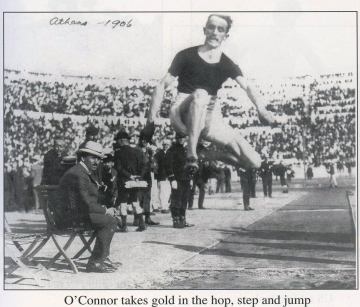
The first 'Olympic' protest also came in 1906 when Peter O'Connor (pictured) who won gold in the hop, step and jump and silver in the long jump. Though born in Cumberland, England he was raised in Wicklow. While Irish and American athletes guarded the foot of the flag pole, he climbed it to take down the Union Flag to replace it with a green one, bearing a harp and the slogan Erin go Bragh (Ireland Forever).
They may no be official Olympics but the 1906 were certainly a precursor to the stand alone games that we know so well. They were the only 'Games' to be in a year not divisible by four until the separation of the Winter Games unto a different 4 year cycle from 1994.
However, they deserve their place in the history of the Games for the 6 reasons listed above which they brought in which will still be present in London 106 years later. But have for too long been airbrushed out.
They may no be official Olympics but the 1906 were certainly a precursor to the stand alone games that we know so well. They were the only 'Games' to be in a year not divisible by four until the separation of the Winter Games unto a different 4 year cycle from 1994.
However, they deserve their place in the history of the Games for the 6 reasons listed above which they brought in which will still be present in London 106 years later. But have for too long been airbrushed out.
The medals awarded, which do not feature in the overall Olympic tables are as follows:
| Rank | Nation | Gold | Silver | Bronze | Total |
|---|---|---|---|---|---|
| 1 |  France France | 15 | 9 | 16 | 40 |
| 2 |  United States United States | 12 | 6 | 6 | 24 |
| 3 |  Greece Greece | 8 | 14 | 13 | 35 |
| 4 |  Great Britain Great Britain | 8 | 11 | 5 | 24 |
| 5 |  Italy Italy | 7 | 6 | 3 | 16 |
| 6 |  Switzerland Switzerland | 5 | 6 | 4 | 15 |
| 7 |  Germany Germany | 4 | 6 | 5 | 15 |
| 8 |  Norway Norway | 4 | 2 | 1 | 7 |
| 9 |  Austria Austria | 3 | 3 | 3 | 9 |
| 10 |  Denmark Denmark | 3 | 2 | 1 | 6 |
| 11 |  Sweden Sweden | 2 | 5 | 7 | 14 |
| 12 |  Hungary Hungary | 2 | 5 | 3 | 10 |
| 13 |  Belgium Belgium | 2 | 1 | 3 | 6 |
| 14 |  Finland Finland | 2 | 1 | 1 | 4 |
| 15 |  Canada Canada | 1 | 1 | 0 | 2 |
| 16 |  Netherlands Netherlands | 0 | 1 | 2 | 3 |
| 17 |  Mixed team Mixed team | 0 | 1 | 0 | 1 |
| 18 |  Australia Australia | 0 | 0 | 3 | 3 |
| 19 |  Bohemia Bohemia | 0 | 0 | 2 | 2 |
| Total | 78 | 80 | 78 | 236 | |
See also:
Subscribe to:
Posts (Atom)