Tuesday, 2 June 2015

Charles Kennedy 1959 - 2015

Just over 10 years ago on the 4th May 2005 I was standing in the ground of the Presontonfield House Hotel in Edinburgh in my suit and tie, just inside a fenced off area it was nearing 6:30pm. I wasn't alone so were all the other Liberal Democrat candidates in the Lothian region, although Marilyn McLaren the candidate for Edinburgh South was the sole one of us not wearing a tie.

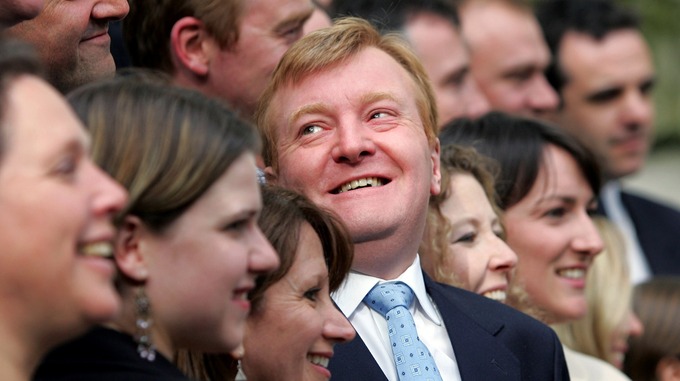
Charles surrounded by those 2005 MPs
The reason was we were waiting for the leader of the party to finish his eve of poll press engagements before he, his wife Sarah and newly born son Donald boarded a helicopter to fly to Inverness ready for polling day the following day. We were saying amongst ourselves that as we walked the family to the helicopter that we should try our best not to look like that scene from Reservoir Dogs.
Sadly at about 7:15am the following morning I learnt from one of our supporters outside a polling station that her husband thought that is what we looked like anyway. Something I then had to explain to Fiona Hyslop MSP who was standing beside me at the time. But by the end of that day we had news MPs Tim Farron in Westmorland and Lonsdale, Mark Williams in Ceredigion and Greg Mulholland in Leeds North West; also Nick Clegg had taken over in Sheffield Hallam from Richard Allen. In other words half of the current parliamentary party was first elected into that total of 62 MPs ten years ago.

Me and Charles from 2005
When I joined the party in 1988 Charles had already been an MP for five years for the former sear of Ross, Cromarty and Skye. He had in 1983 been the shock winner for the SDP against the Conservative Hamish Gray who had held the seat of Ross and Cromarty since 1970, by 1,704 votes. The majority of the seat had been the former Conservatives with only a part of Russell Johnston's seat of Inverness coming into it. He became the baby of the house upon his election and never completed the PhD he was studying for at the time at Indiana University on a Fulbright Scholarship.

From 1997-2005 it would become Ross, Skye and Inverness West, before then becoming the seat of Ross, Skye and Lochaber which he was to hold through 7 Parliaments before losing it to Ian Blackford of the SNP earlier this month.

In the run up to the 2005 election he had led the party's opposition to the war in Iraq, challenging Tony Blair on his dodgy dossier numerous times during PMQs

From 1991-94 he served as President of the Liberal Democrats, before in 1999 taking over as leader when Paddy Ashdown stepped down. He led us through the 2001 and 2005 elections  but there was growing speculation that he had an alcohol problem from missing key speeches in the commons to looking considerably sweaty and confused at other speeches and public appearances. It came to a hear in early January 2006 when ITN told him they were going to report that he had been receiving treatment for alcoholism. On the Saturday evening a letter was circulating around his MPs calling for him to resign immediately and my initial support of the man and his problem led me to write this when I returned home in the small hours. Though this didn't stop BBC Scotland calling me on the Sunday morning to see if I would speak in support of Charles the following morning, but that was superseded by news that he himself would be holding a press conference. It was there that he announced his resignation and that, unlike he had said earlier in the week, he would not be seeking the support of the party in the leadership election he had called.

He returned to the back benches and apparently was the lone voice in the Parliamentary meeting in 2010 that voted against entering the Coalition. But made appearances on game shows including both as a regular guest and occasional guest host on Have I Got News for You.

It was already going to seem strange not seeing him on the Green Benches for the first time in my political life, but now that I will not even ever run into him around party conference or any other political event seems to be the cruellest, most final outcome from the collapse of Liberal Democrat support in last month's election.

My thoughts and prayers are with his young son Donald, who has lost his father and grandfather in the space of two months, as well as his and my wider Liberal Democrat family who have lost someone we all respected for the way he grew the strength of the party in those 7 years he was leader.

To conclude here he is at Lib Dem Conference two years ago on the subject of Europe, a speech where he was back at his best as I and many others who witnessed this in the hall agreed. We'll also like Duncan Brack did in the chair ignore the red light indicating his time was up.


Charles Peter Kennedy 25 November 1959 - 1 Jun 2015

Sunday, 31 May 2015

Why I and most LGBT activists are opposed to a NI referendum on marriage equality #MarRef

There is a petition going around demanding that, like the Republic of Ireland, Northern Ireland should have a referendum to bring about marriage equality.

I and the majority of LGBT+ groups in Northern Ireland are opposed to the idea, which was first muted by Sinn Féin in the run up the the referendum in the republic and here are the reasons why.

1. There is not need for a referendum to bring about marriage equality in any part of the UK. In the Republic of Ireland there had to be a constitution change to recognise marriage equality. The only way to do so, based on that constitution, was to hold a referendum. In Scotland a simply Bill was required in Holyrood and for England and Wales a Bill before Westminster was enough to bring about such change. Such a bill would still need to be brought before the Northern Ireland Assembly to bring about any change.

2. A referendum is not legally binding in the UK.  A referendum does not necessarily have legal binding on UK legislators to bring about change. Admittedly often they do bring about the change or endorse the decision of the referendum but there actually is nothing to prevent the legislative body with responsibility. Indeed if such a referendum were to come about in Northern Ireland there is nothing to prevent a petition of concern being used, by let's say the DUP, the prevent subsequent legislation coming into effect.

3. Public debate is not as mature on this issue in NI as the RoI. Despite legalising homosexuality later than the North the Republic of Ireland is at a far more mature level of debate on this issue than the North. Yes there are some stupid and ridiculous comments made by some of those opposed in the Republic, but the level of the political debate between the politicians, even those who disagreed with their parties stance, was far more civil and factually based than the largest party in Northern Ireland has shown again the recent election and aftermath to be able to carry on over issues of LGBT equality.

4. Both the two biggest parties are viewing LGBT equality as a political football. I'm sorry to say this but since it was first mooted that NI should have equal marriage Sinn Féin's support has become as much of a political football as the DUP's opposition to it has. This is no more evident than the poor timing of the last debate in Stormont and the call for this referendum now. Most LGBT activists were certain that the time to strike next in Stormont to seek marriage equality should have been after the referendum result in the Republic was known. But Sinn Féin decided that the 28th April (ie during the short campaign for Westminster) was the time to put the motion before the Assembly for the fourth time. This timing was poor and could only have come from a party that did not consider Westminster elections to be important. Most LGBT activists with party affiliation outside Sinn Féin were too busy with the election to lobby MLAs and get into a big campaign on this occasion. While the DUP have in the past picked on Sinn Féin President Gerry Adams saying that equality is a Torjan Horse by which to beat the DUP I would say that recent actions overlooking the views of the LGBT community shows they do not really understand the nature of this equality.

The DUP meanwhile use their opposition to LGBT equality as a means to shore up their core vote, although having lost Antrim South to a pro-marriage equality Unionist and seen the Alliance vote pick up a great deal of the UUP vote in East Belfast it would appear it is a tactic that only has limited appeal.

5. Should a socially conservative majority have a say on minority rights? In the Northern Ireland Act we actually have a statutory requirement for the public bodies to allow equality of opportunity for various groups, this includes marital status and sexual orientation. Would such a referendum actually fit within the statutory obligations of our public bodies? I do not feel it does. Even though recent opinion polls are showing that there is now a majority in favour of supporting marriage equality here, there is a danger that the most socially conservative part of the UK could be ground down in a particularly heated campaign to vote no on the day. Also many LGBT people already know the sort of vitriol that some politicians or campaigners already direct towards us when our rights aren't the focus of a campaign, we can only envision it getting ugly if they were the sole focus. Also if the social conservatives were to squeak a narrow majority, it would set back any hope of reform for 10-20 years, when we are only trailing a couple of years behind the rest of the UK and Ireland at present. People's rights for equality should not be placed in the hands who have privilege to determine the extension of those rights.

Thursday, 28 May 2015

Thank you Mr Dodds for the encouragement

Yesterday in the House of Commons debate on the Queen's Speech Nigel Dodds said:

"He is certainly proof that if we work at and fight for an issue that we believe in, we will get there in the end, especially if the cause is right."

Now the comment was directed at Sir William Cash and in relation to the EU referendum that has been promised in Queen's speech, but as an LGBT campaigner in Northern Ireland I take this as encouragement. Because also later when responding to his colleague Sammy Wilson he said:

"My hon. Friend raises an important issue, which is one of those that arise out of the Belfast agreement. As he knows, equality provisions under section 75..."

Although he did continue "work against giving our armed forces veterans the same status as those in the rest of the United Kingdom." the fact is that a DUP MP has acknowledged the Northern Ireland Act/Belfast Agreement and knows about section 75 is something.

But back to that first comment in relation to William Cash. The wave of rightness is on the side of those supporting Equal Marriage. Yesterday Greenland became the latest state to legislate for it in a unanimous vote. Since the referendum result in Ireland was announced Austrialian Prime Minister Tonny Abbott said he wouldn't stand in the way of a conscience vote. Also Italian Prime Minister Matteo Renzi is about to fast-track the civil union legislation that has been stalled for a number of months.

Only Germany of the list of Western countries that Peter Lynas listed on Nolan as not having marriage equality the other day has not announced any plans to move forward on this issue since the referendum. Although there have been calls from the opposition Green/Alliance 90 leader Katrin Göring-Eckardt for Germany to move on this, Angela Merkel is remaining adamant it is not the goal of her CDU/CSU party (the only one in Germany opposed) in this Government.

Therefore the LGBT community should take encouragement that even Nigel Dodds that "if we work at and fight for an issue that we believe in, we will get there in the end".

Sunday, 24 May 2015

Presbyterian Church in Ireland seek to redefine victimhood

I am saddened to read the statement of the PCI in light of the decision made by over 62% of those who voted in Marriage Referendum in Ireland. So much so that I feel it needs a few comments from me.

The Presbyterian Church in Ireland has issued the following statement on the result of the Marriage Referendum.
Commenting on the result the Very Rev. Dr. Norman Hamilton, Convener of the Presbyterian Church in Ireland’s Council for Church in Society said, "We are deeply disappointed and saddened that the Constitution will no longer reflect the historic – and Christian – view of marriage that it is exclusively between one man and one woman; the position the Presbyterian Church in Ireland upholds and maintains. The Constitution of Ireland only came into effect on 29 December 1937. On the 17th June 1996 the referendum on the 15th Amendment allowed for Divorce in that constitution and indeed "Divorce does not prevent you from getting married in the Presbyterian Church" - Getting Married in the Presbyterian Church in Ireland
"The issue before voters was an intensely emotive one and to express the historic view of marriage during the referendum campaign often brought hostility and rejection yes and indeed some of the comments from Very. Rev. Dr. Norman Hamilton appear to have not been following the Pastoral Guidelines on Same Sex Attraction. We hope that those who continue to uphold this view will not be marginalised or demeaned. We would also encourage all Christians to love their neighbours – as the Bible calls us to do – particularly those with whom we might disagree and if demeaned, to turn the other cheek, for Jesus' sake. Wow! In recent days I have received a number of comments from "Christians" that demean me, as have straight friends who have supported the cause. I called on Christian groups to stand up against these so called Christians pouring oil on the flames with their words and have heard nothing from that end, this line appears to ignore the demeaning that has been going on from the side of the Churches in recent days and it is bit late to call on loving of neighbours, without clearer instruction,
"While the result is a significant change for Irish Society, as a Church we will continue to reach out to all people, whatever their situation, as all are equally welcome. I have written previously that currently my past experiences over this very issue have made me feel less than welcome. If anyone from the PCI wants to actually enable a safe space to talk about these things with Presbyterians who are LGBT I would welcome that action point being followed through from the pastoral guidelines and would be willing to contribute.
"Whilst reaffirming our understanding of marriage as exclusively between one man and one woman, we pray for wisdom for the Government and urge it to consult faith groups over the coming months as it formulates the necessary subsequent legislation." I trust that the Irish Government will do the same as those of Scotland, England and Wales and leave the option for Faith Groups to come to their own decision on whether they carry out same sex marriages. While the PCI may currently be that way minded other faith groups should have the same freedom of religious expression that they themselves want. Because here is the thing LGBT groups are not trying to force churches to marry them, they want them to choose to marry them, but they only want the barriers to be taken down to allow civil marriage and truly welcoming faith groups to carry them out.

42 is a number I like #MarRef

When Roscommon - South Leitrim voted no to the Irish referendum on marriage equality I was a little upset that it wouldn't be unanimous. However, I was not too concerned as this was only by a margin of 1,029 votes and barely nibbled into the overall trend of the votes that were being announced.

I had to leave for a Eurovision party before the three Cork county seats declared, but in the end this left Roscommon - South Leitrim as the sole red mark on the map. The other forty-two constituencies had all by either a small (only 33 votes in Donegal South West) to a large (27,959 in Dublin South) margin voted yes. Overall  1,201,607 people voted Yes/Tá to 734,300 voting No/Níl 62.1% to 37.9%.

But as a gay Irish and British Douglas Adams fan I was most chuffed by the result of this question:

How many of the Irish constituencies voted Yes to marriage equality?

FORTY-TWO

Yes the interconnectiveness of all things would have delighted Douglas with that result.

But the other question is where does that leave Northern Ireland, which is now the largest region of the British Isles that does not have equal marriage in any shape of form allowing people of the same-sex to marry?

Firstly I turn to the Northern Ireland Act, which recognises that the people of Northern Ireland can identify as British or Irish or both. This is key now to moving forward. Then I also note that

Section 75 and Schedule 9 to the Northern Ireland Act 1998 came into force on the 01 January 2000 and placed a statutory obligation on public authorities in carrying out their various functions relating to Northern Ireland, to have due regard to the need to promote equality of opportunity –
  • between persons of different religious belief, political opinion, racial group, age, marital status or sexual orientation;
  • between men and women generally;
  • between persons with a disability and persons without; and
  • between persons with dependants and persons without.
In addition, without prejudice to this obligation, Public Authorities are also required to have regard to the desirability of promoting good relations between persons of different religious belief, political opinion, and racial group.
Bearing in mind that people can identify as Irish or British in order to promote equality of opportunity for those LGBT people who identify as either or both they must also have the same promotion of equality for their marriages as anyone else. We cannot carry on not recognising all GB or RoI marriages and downgrading them as civil partnerships, that is not promoting equality of opportunity on marital status, nor sexual orientation.

If unionism do not live up to their statutory obligations on this now there is legal case to take this higher to the UK Supreme Court or Europe.

Thursday, 14 May 2015

Manning the barricades

Picture credit via Richard Morris
Apparently now it is not enough to merely obey the law to be tolerated by the Tories.

Speaking at the National Security Council today David Cameron said:

"For too long, we have been a passively tolerant society, saying to our citizens 'as long as you obey the law, we will leave you alone'. 
"It's often meant we have stood neutral between different values. And that's helped foster a narrative of extremism and grievance."

Now my values are different from those of Tories and I have no doubt I will have grievances with them as they set about their own agenda. Indeed I already have over the Human Rights Act, snooper's charter and our role in Europe.

I like living in a passively tolerant society. It allows me to be a gay man for a start, what goes on behind my closed bedroom door is my own concern. Of course the Tories want to do away with that an keep my internet browsing history. As any fan of Avenue Q  knows the internet is really, really great...for porn. So  by keeping our internet browser history the Government would know that we find really, really great on t'Internet. So maybe what I get up to in my bedroom (or anyone else's bedroom) or other rooms for that matter may not be quite so much my own business as I would expect in a tolerant society.

We are celebrating the 800th anniversary of Magna Carta aka Magna Carta Libertatum (Great Charter of the Liberties). The Tories seem to want to celebrate by taking away more of our liberties.

Tuesday, 12 May 2015

All for coalitions but not campaigning for one

As someone who believes we should have a proportional voting system it makes sense that I am in favour of coalitions. These are the most likely outcome after all if the votes cast more closely reflect the number of seats won in any multi-party system.

However, what I hope I never end up doing again is campaigning for a coalition and to be part of one. In 2010 the Liberal Democrats stood on our liberal values, we stood on our ideals, we stood on the policies that had been decided democratically by conference. The people liked what they saw and gave us a higher percentage of the vote than at any point since the merger.

This time we spent it seems the Liberal Democrats spent more time angling for a coalition and not selling our good liberal policies.

We didn't sell our justice and prison reform policies which had a radical focus on cutting re-offending, only giving custodial sentences to the most dangerous prisoners and reinstating local accountability through police and justice boards instead of elected PPCs.

We did often mention our radical take on mental health being treated the same as physical health. But this got lost in our calling out one other party for not providing costs to match our £8bn a year commitment to the NHS and the other for failing to even promise this. We were leading on health and we should have been shouting it from the rooftops.

We had as always green issues at the heart of our manifesto with out five green laws. Laws that didn't restrict business from aiding the economic recovery but had radical ideas for housing, for infrastructure, our countryside and so much more.

Our call for greater civil liberties, an online Bill of Rights and media "first amendment" and protection the Human Rights Act all got lost in the scrum. All things that are vital to every person. But not just what we would do but why we consider such things important.

We and the nation lost some of the strongest voices on LGB & T rights. Julian Huppert got the issue of the spousal veto and need for humanists to be be treated equally with other faiths in respect to marriage (just as they can in Scotland). Lynne Featherstone who got marriage equality unto the agenda at all.

The Fightback that the Liberal Democrats are already getting involved in, has to place our values to the forefront. What we want to do in Government, what values we have that would direct how we act if given the chance to serve, how we would make society fairer and the economy stronger. If others want to copy our ideas there is no shame in that, they have done for years anyway and even take credit for things that only we were prepared to do.

But we need to shout about what we want to do. We also need stand up against the things we would never do. We will stand on our record, stand on our believes, stand on our values.

But one thing we must do is we must stand at Liberal Democrats first and foremost not as someone else's lapdog.